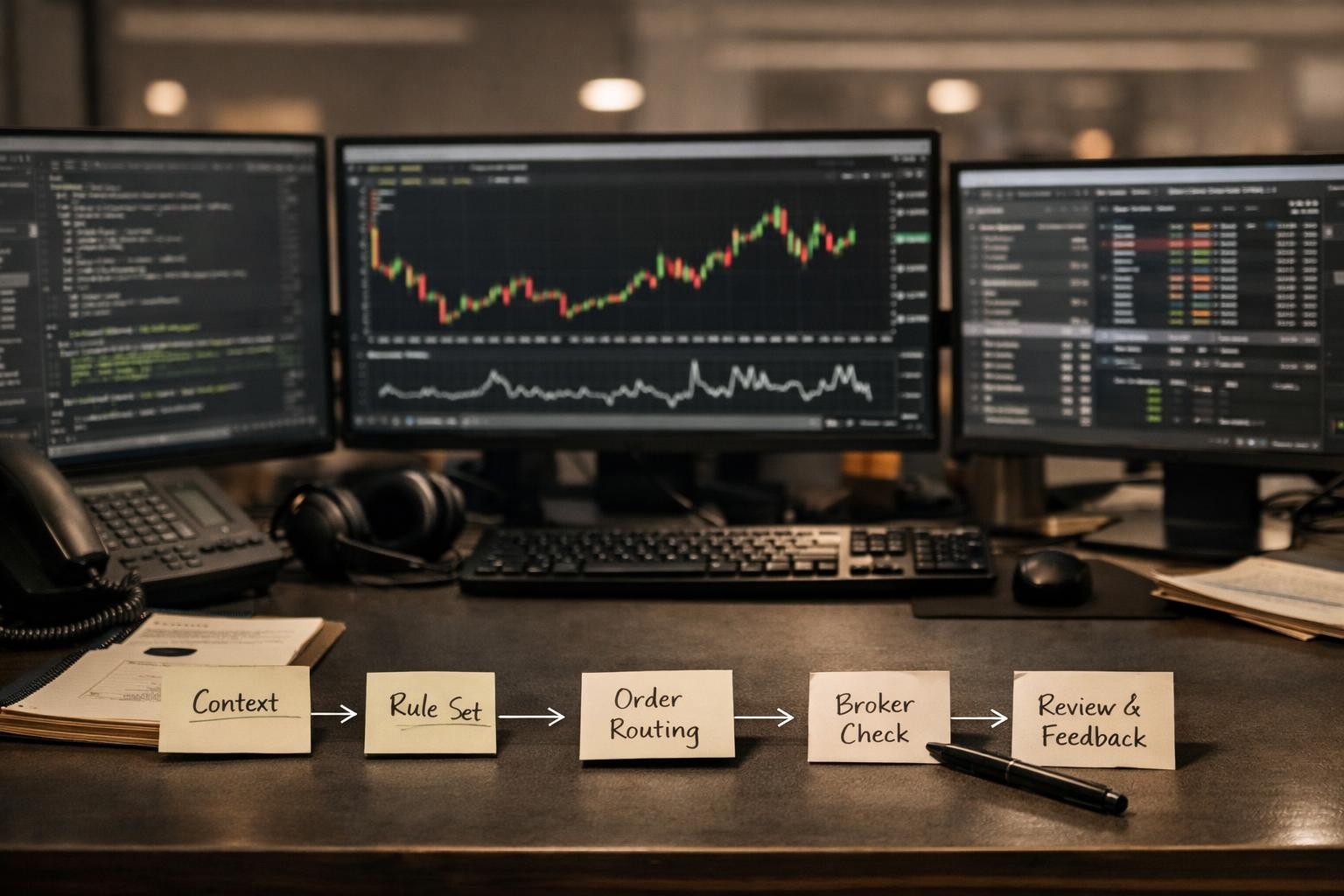
Key takeaways
- Backtesting TradingView alerts can validate rule logic, frequency, and broad expectancy, but it cannot fully validate live delivery, broker routing, slippage, rejects, stale state, or account synchronization. The real job is to turn the trading idea into a payload, validation path, and fail-safe workflow that can be trusted live. One of the first numbers to define is webhook delivery timeout: 3 seconds.
- Backtests are strongest when validating logic consistency and broad behavior across different market conditions
- Webhook delivery timeout: 3 seconds.
- A common failure is treating backtests like proof that live automation is production-ready.
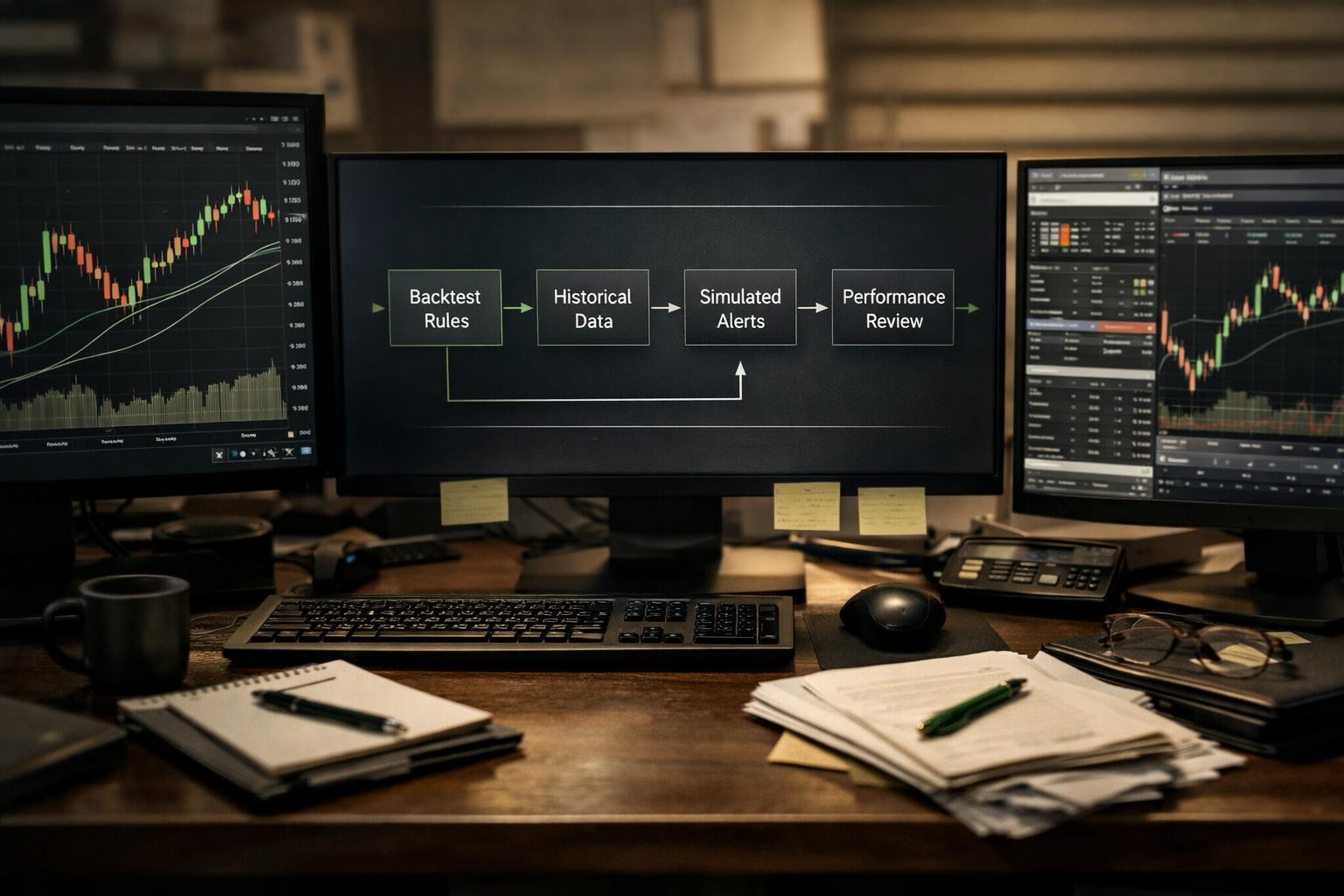
Backtesting TradingView alerts can validate rule logic, frequency, and broad expectancy, but it cannot fully validate live delivery, broker routing, slippage, rejects, stale state, or account synchronization. The real job is to turn the trading idea into a payload, validation path, and fail-safe workflow that can be trusted live. One of the first numbers to define is webhook delivery timeout: 3 seconds. This guide keeps the topic practical. Instead of circling the idea in broad terms, it moves through the actual decision chain: what the topic is, which rules matter, which numbers have to be defined early, how the setup is applied, what usually breaks, and how the session should be reviewed afterward.
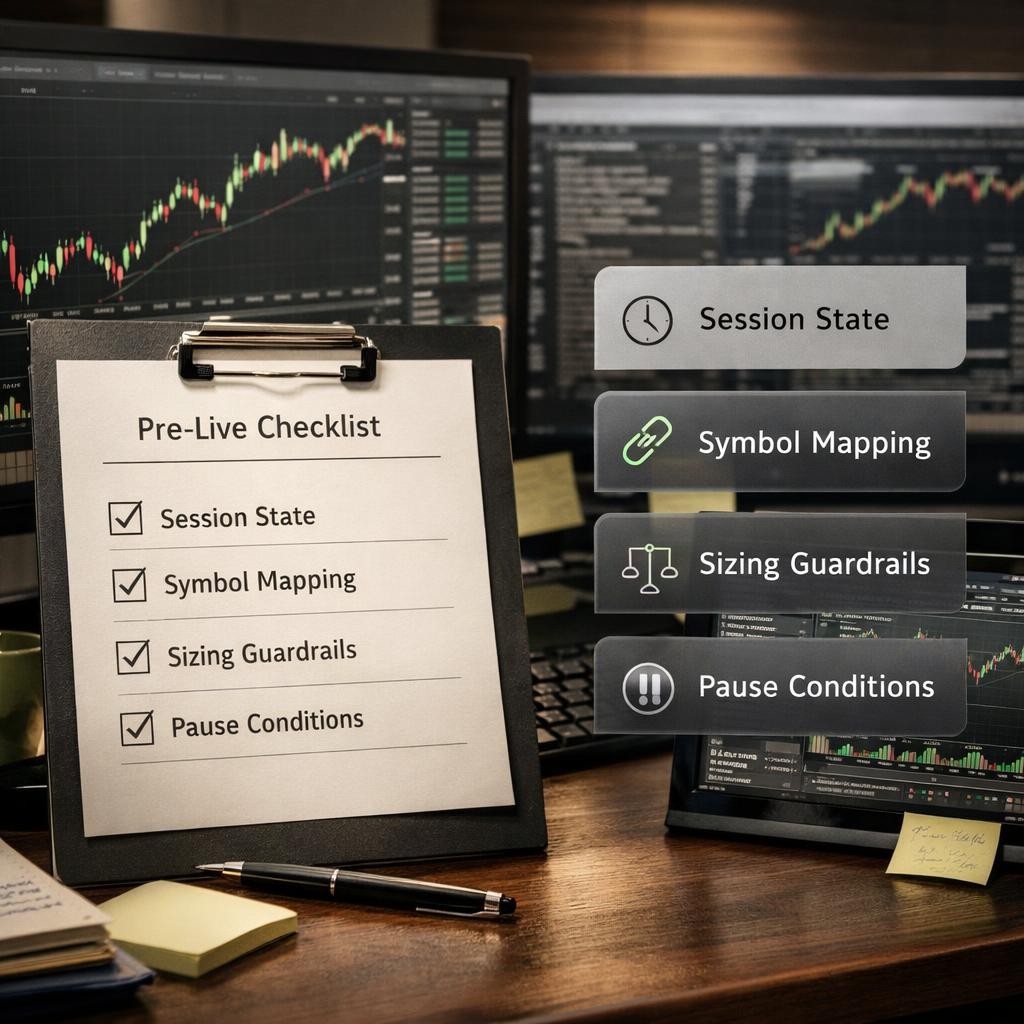
For backtesting TradingView alerts, the useful version is the one a trader can explain from the chart, the note, the sizing worksheet, or the alert payload without inventing missing context after the move.
What the automation has to do correctly
A trader should be able to point to backtesting tradingview alerts what you can validate before going live and what only live execution reveals, TradingView alert backtesting, automation testing, and paper trading webhooks before trusting the setup with normal size. If those nouns are not visible in the chart note, payload, sizing worksheet, or review entry, the topic is still too vague to trade cleanly.
That is what separates a topic from a label. The article has to leave the trader with something observable to verify: a level, a field, a stop distance, a review question, or a no-trade condition that can still be identified while the session is unfolding.
Use the topic to answer one blunt question before the trade: What did the backtest validate and what did it leave untested? If the answer stays fuzzy, the setup has not earned risk yet.
Prerequisites and context before the trade
Before the trigger matters, the trader needs the surrounding context written clearly enough that another operator could explain why the setup is valid, weak, or inactive.
Context check 1
Backtests are strongest when validating logic consistency and broad behavior across different market conditions. This should be visible before the trade, not discovered by replaying the chart later.
If this prerequisite is missing, the trade usually becomes harder to size, harder to manage, and easier to rationalize after the fact.
Context check 2
Backtests are weak at capturing live operational issues such as webhook delivery, broker translation, and state mismatch. If the trader cannot point to this condition before entry, the setup is still too loose to trust.
When this prerequisite is skipped, weak entries often look acceptable right up until the review exposes the missing context.
Context check 3
A live automation stack must be tested end to end, not only inside TradingView. Treat this like a written prerequisite, not a feeling that gets filled in after the move.
Missing this prerequisite usually shows up later as late entries, wider stops, or a note that cannot explain why the trade was valid.
Context check 4
The right question is not “Did the backtest look good?” but “What parts of the trade chain are still untested?”. This belongs in the plan before the session opens so the trade can be filtered quickly under pressure.
A missing prerequisite here usually means the trader is relying on memory or optimism instead of a rule that can survive speed.
The decision rules and validation logic that matter
These are the rules that should change the trade or the no-trade decision before execution begins.
If a rule does not change size, timing, routing, or the decision to stay flat, it is not doing much work. Good decision rules narrow the workflow before volatility speeds up and before the trader starts negotiating with the setup in real time.
Rule 1: Backtests are strongest when validating logic consistency and broad behavior across different market conditions
If backtests are strongest when validating logic consistency and broad behavior across different market conditions, backtest the strategy logic first to validate trigger rules and rough performance characteristics.
Why it matters: TradingView will cancel webhook requests that take too long, so alert endpoints need to acknowledge quickly and push longer work downstream
If the rule cannot be checked quickly in the live workflow, tighten it until the decision is obvious from the note, chart, or payload.
Rule 2: Backtests are weak at capturing live operational issues such as webhook delivery, broker translation, and state mismatch
If backtests are weak at capturing live operational issues such as webhook delivery, broker translation, and state mismatch, paper trade or route tiny size to validate the end-to-end stack: alert, middleware, broker, fills, and position management.
Why it matters: A valid routing path still fails if the webhook destination requires unsupported ports or brittle endpoint assumptions
A strong rule is one the operator can verify in seconds without inventing missing context.
Rule 3: A live automation stack must be tested end to end, not only inside TradingView
If a live automation stack must be tested end to end, not only inside TradingView, compare the TradingView alert log, the automation platform log, and the broker fills after every test session.
Why it matters: Automation quality improves when the payload, routing, and broker translation are observed across many examples before capital is exposed
If the rule still needs interpretation under pressure, the workflow is not ready for normal size.
Rule 4: The right question is not “Did the backtest look good?” but “What parts of the trade chain are still untested?”
If the right question is not “Did the backtest look good?” but “What parts of the trade chain are still untested?”, backtest the strategy logic first to validate trigger rules and rough performance characteristics.
Why it matters: Readers want to know what backtests are good for in alert-driven automation and where live testing still matters
Use the rule to narrow the action set before the market accelerates, not to explain the trade afterward.
Key numbers, fields, and constraints to define before go-live
Strong trading tutorials surface the numbers early. They make the trader define the range, threshold, or constraint before the trigger gets attention.
Table 1: Working ranges and thresholds
| Item | Working range | Why it matters |
|---|---|---|
| Webhook delivery timeout | 3 seconds | TradingView will cancel webhook requests that take too long, so alert endpoints need to acknowledge quickly and push longer work downstream. |
| Accepted TradingView webhook ports | 80 and 443 only | A valid routing path still fails if the webhook destination requires unsupported ports or brittle endpoint assumptions. |
| Dry-run standard | 20+ alert simulations before live size | Automation quality improves when the payload, routing, and broker translation are observed across many examples before capital is exposed. |
These numbers should be written before the trade so they can shape the decision while the market is still moving, not after the fact. Read the item column first, then use working range to decide whether the setup still deserves risk, needs smaller size, or should be skipped outright.
Step-by-step implementation
Use the topic in this order so the decision stays clear before the market starts moving too fast to improvise cleanly.
Step 1: Backtest the strategy logic first to validate trigger rules and rough performance characteristics
Backtest the strategy logic first to validate trigger rules and rough performance characteristics. This step should remove one source of ambiguity before the trade is active.
Rule to verify here: Backtests are strongest when validating logic consistency and broad behavior across different market conditions. If that is not true, backtest the strategy logic first to validate trigger rules and rough performance characteristics.
Useful range or threshold: Webhook delivery timeout -> 3 seconds. TradingView will cancel webhook requests that take too long, so alert endpoints need to acknowledge quickly and push longer work downstream.
Write down what would cancel this step before the trade goes live so the review can later confirm whether the gate was respected.
Step 2: Paper trade or route tiny size to validate the end-to-end stack: alert, middleware, broker, fills, and position management
Paper trade or route tiny size to validate the end-to-end stack: alert, middleware, broker, fills, and position management. Do not move on until the evidence for this step is visible in the chart, note, or payload.
Rule to verify here: Backtests are weak at capturing live operational issues such as webhook delivery, broker translation, and state mismatch. If that is not true, paper trade or route tiny size to validate the end-to-end stack: alert, middleware, broker, fills, and position management.
Useful range or threshold: Accepted TradingView webhook ports -> 80 and 443 only. A valid routing path still fails if the webhook destination requires unsupported ports or brittle endpoint assumptions.
Note the condition that would invalidate this step so the trader is not negotiating with it mid-trade.
Step 3: Compare the TradingView alert log, the automation platform log, and the broker fills after every test session
Compare the TradingView alert log, the automation platform log, and the broker fills after every test session. If this part stays fuzzy, the trade usually becomes harder to review honestly later.
Rule to verify here: A live automation stack must be tested end to end, not only inside TradingView. If that is not true, compare the TradingView alert log, the automation platform log, and the broker fills after every test session.
Useful range or threshold: Dry-run standard -> 20+ alert simulations before live size. Automation quality improves when the payload, routing, and broker translation are observed across many examples before capital is exposed.
If the evidence for this step disappears, the workflow should have a documented fallback instead of a guess.
What the setup looks like in a live session
The point of a live walkthrough is to show the order of decisions while the information is still incomplete. That is what separates a practical trading article from a post-trade narrative.
Session moment 1
The trader backtests an alert-based breakout system and sees consistent behavior across several months. At this point the trader should be able to name the location, the condition that still makes the setup valid, and the line that would cancel it.
The useful question here is simple: What did the backtest validate and what did it leave untested? If the answer is still vague during the session, the trader usually needs to reduce size, wait for better evidence, or stay flat.
At this stage the operator should still be able to name the trigger, the invalidation, and the fallback response without opening a second chain of reasoning. If that answer needs storytelling, the workflow has already drifted away from the written plan.
Session moment 2
In live paper routing, the team discovers duplicate alerts during state transitions and a symbol-mapping mismatch. At this stage the trade should still have a clear reason to exist, a clear reason to stay inactive, and a clear reason to be abandoned if the read deteriorates.
The useful question here is simple: Did live routing match TradingView intent exactly? A fuzzy answer here is usually a sign that the setup should be downgraded, delayed, or ignored instead of forced.
The step is only useful if the trader can explain what would cancel the idea immediately, what would downgrade size, and what evidence would keep the plan intact under pressure.
Session moment 3
The logic may still be sound, but the operational stack is not ready until those issues are fixed. This is the moment where the trader has to decide whether the evidence is improving the setup or simply making the chart busier.
The useful question here is simple: What operational failure appeared only in live conditions? If this question cannot be answered in real time, the workflow has probably moved faster than the written process can support.
This is also where the written process proves whether it is operational or decorative. If the trader cannot point to the exact field, level, or rule that controls the next action, the setup is still too loose.
Pre-live verification table
Automation fails most often before the first live fill, when a payload looks plausible but still leaves the router or broker adapter guessing. This table makes the pre-live checks explicit for backtesting TradingView alerts.
Table 1: Pre-live verification table
| Check | What to verify | Pass condition |
|---|---|---|
| Payload format | Alert body is valid JSON | application/json arrives at the endpoint |
| Symbol mapping | TradingView symbol maps to broker symbol | No fallback guesswork in translation |
| Risk guardrail | Quantity or risk fields respect account limits | Order blocks when risk exceeds policy |
| Session control | Allowed trading window is enforced | Alert outside the window is ignored or paused |
A good pre-live table focuses on what can silently go wrong before the alert ever becomes an order. Read the check column first, then use what to verify to decide whether the setup still deserves risk, needs smaller size, or should be skipped outright.
Failure mode matrix
If a workflow has no documented response for malformed payloads, symbol mismatches, stale account state, or broker rejects, the system is still relying on luck. The matrix below should make the safe default action obvious.
Table 1: Failure mode matrix
| Failure mode | What it looks like | Immediate response |
|---|---|---|
| Invalid JSON | Webhook arrives as text or malformed JSON | Reject and log the payload |
| Symbol mismatch | Alert symbol does not map cleanly to the broker | Pause routing and require operator review |
| Stale account state | Open position or balance assumption is wrong | Block new order and refresh account state |
| Broker reject | Adapter returns a validation error | Log the exact reject reason and stop blind retries |
Automation gets safer when each failure mode has a documented default action before it happens live. Read the failure mode column first, then use what it looks like to decide whether the setup still deserves risk, needs smaller size, or should be skipped outright.
Field-by-field example
A field-by-field example keeps the automation discussion anchored to what the system actually has to read and enforce when a live alert arrives. The goal is to make the routing contract explicit enough that a second operator could audit the alert without guessing what the sender meant.
{
  "strategy": "backtesting-tradingview-alerts-what-you-can-validate-before-going-live-and-what-only-live-execution-reveals",
  "ticker": "CME_MINI:ES1!",
  "side": "buy",
  "orderType": "market",
  "riskDollars": 100,
  "maxSlippageTicks": 4,
  "session": "RTH",
  "setup": "backtesting_tradingview_alerts",
  "timestamp": "2026-04-12T13:35:00Z",
  "notes": "dry-run payload example"
}
The fields matter for different reasons. ticker, side, and orderType define the basic instruction. riskDollars and maxSlippageTicks define whether the trade is still acceptable once real execution friction shows up. session and setup keep the alert tied to the exact operating context instead of relying on memory.
A good operator review asks the same three questions for every field: who sets it, what values are valid, and what the system should do when it is absent or malformed. If those answers are different in TradingView, the router, and the broker adapter, the workflow is still relying on luck.
This is also the fastest way to spot hidden assumptions. If the operator cannot explain why a field exists, which values are valid, and what should happen when it is missing, the payload is not ready for live capital. The live contract is only trustworthy when repeated dry runs produce the same interpretation every time.
Operational constraints that matter live
The idea behind the setup may be discretionary, but the transport layer is not. These numbers are the constraints the workflow has to respect long before the trader starts caring about alpha.
Metric 1: Webhook delivery timeout
Webhook delivery timeout matters because TradingView will cancel webhook requests that take too long, so alert endpoints need to acknowledge quickly and push longer work downstream.
- Working number: 3 seconds
- Why it changes the decision: TradingView will cancel webhook requests that take too long, so alert endpoints need to acknowledge quickly and push longer work downstream.
- How to use it: Translate webhook delivery timeout into the setup, the size, or the skip decision before the trade is live.
Write webhook delivery timeout into the plan before the session starts so the number can be checked without improvising.
Metric 2: Accepted TradingView webhook ports
Accepted TradingView webhook ports matters because A valid routing path still fails if the webhook destination requires unsupported ports or brittle endpoint assumptions.
- Working number: 80 and 443 only
- Why it changes the decision: A valid routing path still fails if the webhook destination requires unsupported ports or brittle endpoint assumptions.
- How to use it: Translate accepted tradingview webhook ports into the setup, the size, or the skip decision before the trade is live.
If accepted tradingview webhook ports changes during the session, the trader should know exactly whether that means smaller size, slower timing, or no trade.
Metric 3: Dry-run standard
Dry-run standard matters because Automation quality improves when the payload, routing, and broker translation are observed across many examples before capital is exposed.
- Working number: 20+ alert simulations before live size
- Why it changes the decision: Automation quality improves when the payload, routing, and broker translation are observed across many examples before capital is exposed.
- How to use it: Translate dry-run standard into the setup, the size, or the skip decision before the trade is live.
A useful metric becomes part of the review when the trader can compare the planned dry-run standard with what actually happened live.
Worked example: applying the topic in real conditions
A good worked example is useful because it shows the order of decisions instead of presenting the finished result only after the move.
Worked example 1: TradingView-to-execution dry run
A trader routes a TradingView alert through TradeLink to a futures broker and wants to confirm that the payload, symbol mapping, and account guardrails behave the same way in simulation and in live mode.
- Define every required field explicitly: ticker, side, orderType, quantity or risk rule, strategy identifier, and any session or account guardrails.
- Send a clean JSON payload in a dry-run environment and confirm the app receives application/json rather than plain text.
- Verify symbol translation, open-position assumptions, and pause conditions before allowing a live order.
- Review the event trail after each simulation so missing fields or ambiguous values are fixed before the next run.
The important part of this example is the decision chain. Automation quality comes from eliminating ambiguous fields before the first live alert, not from debugging them after a rejected order.
A strong worked example should still be useful when the next chart looks different. The trader should be able to reuse the same sequence of checks, thresholds, and adjustments without needing the exact same screenshot to justify the decision.
That usually means the example leaves behind something reusable: a formula, a field check, an invalidation distance, a size adjustment, or a review prompt that can be copied into the next session plan with only the numbers changed.
Troubleshooting and failure modes
This is where the topic usually breaks in real trading: not because the trader never heard the idea, but because the implementation drifted away from the rule.
Symptom 1: Treating backtests like proof that live automation is production-ready
Likely cause: Backtests are strongest when validating logic consistency and broad behavior across different market conditions
Fix: Backtest the strategy logic first to validate trigger rules and rough performance characteristics
Correct the workflow before the next trade instead of writing a cleaner excuse for the last one.
Symptom 2: Ignoring operational edge cases because the strategy logic looked profitable
Likely cause: Backtests are weak at capturing live operational issues such as webhook delivery, broker translation, and state mismatch
Fix: Paper trade or route tiny size to validate the end-to-end stack: alert, middleware, broker, fills, and position management
The fix only counts if the next simulation proves the workflow changed in a measurable way.
Symptom 3: Skipping live small-size rehearsal before scaling
Likely cause: A live automation stack must be tested end to end, not only inside TradingView
Fix: Compare the TradingView alert log, the automation platform log, and the broker fills after every test session
A troubleshooting note should end with a changed rule, not with a more flattering explanation.
When the topic should stay inactive
A strong guide should also tell the trader when the setup does not deserve capital. That is where the written rule often protects more money than the entry pattern itself.
No-trade filter 1
Treating backtests like proof that live automation is production-ready. If that condition is already visible before the order is sent, the cleaner decision is usually to pass, reduce size, or wait for a better version of the setup.
This filter matters most on the days when the trader is tempted to force the setup because the session is active but not actually clean.
A no-trade filter is part of the edge because it protects the conditions that make the next clean setup worth trading. If the filter is already broken before entry, the account usually benefits more from preserved capacity than from another forced attempt.
No-trade filter 2
Ignoring operational edge cases because the strategy logic looked profitable. When that condition is already obvious, the setup is usually stronger as a no-trade decision than as a forced entry.
Most avoidable damage starts here, when a trader knows the condition is weak but still wants the label to count as permission.
This is where discipline protects future opportunity. Passing on a broken setup keeps capital, attention, and rule integrity available for the next trade that actually deserves them.
No-trade filter 3
Skipping live small-size rehearsal before scaling. If this is already on the screen before the order is sent, staying flat usually protects more edge than arguing with the label.
The test is not whether the setup can be defended afterward. The test is whether it deserves capital while the evidence is still incomplete.
The practical job of this filter is to preserve decision quality. When the warning sign is already obvious before entry, protecting the account is usually the higher-value trade.
Live checklist and review framework
This section should leave the trader with a short list that can be used before the session and again after it. This is what keeps the topic actionable.
Before the trade
- Validate signal logic separately from routing behavior
- Run end-to-end paper or tiny-size tests
- Audit alert logs against broker activity
- Test rejects, stale positions, and pause conditions
- Scale only after the live chain behaves consistently
After the session
- What did the backtest validate and what did it leave untested
- Did live routing match TradingView intent exactly
- What operational failure appeared only in live conditions
If the answers stay vague, the next revision should simplify the rule instead of adding another exception.
A good checklist section should shorten tomorrow’s decision, not just summarize today’s. The output of this review is usually one cleaner trigger, one clearer filter, or one narrower risk rule that makes the next live session easier to execute honestly.
That is also how the article becomes practical over time. The trader should be able to reuse the same before-trade checklist and after-session questions across multiple market conditions without rewriting the standard from scratch every time.
Bottom line
Backtesting TradingView alerts: what you can validate before going live and what only live execution reveals should give the trader a better live decision, not a better post-trade explanation. The durable version of this topic is the one that survives the note, the chart, the sizing rule, and the review without needing hindsight to make it look coherent.
If you remember only one thing, make it this: Backtests are strongest when validating logic consistency and broad behavior across different market conditions Then check Webhook delivery timeout before sending risk. That combination usually does more to improve results than adding more opinions or more indicators.
The practical edge comes from documenting the workflow clearly enough that the next session starts with fewer assumptions, fewer avoidable mistakes, and a much cleaner answer to the question of whether the setup deserves risk at all.
That is the real standard for backtesting TradingView alerts: the article should leave behind a rule the trader can execute, audit, and improve under pressure. If the write-up cannot survive a live checklist, a sizing worksheet, or a routing log, the idea is still too soft for capital.
The version worth keeping is usually not the most complicated one. It is the one that helps the trader make the next real-time decision faster, with fewer assumptions, clearer failure points, and a better reason either to take the trade properly or to stay out of it completely.
If the article did its job, the trader should be able to carry one or two lines from it straight into the next plan: the condition that proves the setup, the condition that cancels it, and the response that protects capital when the read weakens. That is the difference between helpful trading guidance and content that only sounds disciplined.
Frequently asked questions
Can a TradingView backtest prove that automation is safe to run live?
No. It can validate logic, but it cannot fully validate live webhook delivery, broker behavior, or all execution edge cases.
What is the most important live test?
The most important live test is the full chain: alert, middleware, broker, fills, position sync, and pause logic.
Why do live results differ from backtests?
Because live environments include slippage, latency, rejects, partial fills, and infrastructure issues that the backtest cannot fully capture.
Newer
Support and resistance for active traders: how to mark usable levels without cluttering the chart
Older